
Saints Herodian, Agabus, Rufus, Asyncritus, Phlegon, and Hermes are among the Seventy Disciples, chosen by Christ and sent by Him to preach.
The holy Disciple Herodian was a kinsman of the Apostle Paul and his companion on many journeys. When Christianity had spread to the Balkan Peninsula, the Apostles Peter and Paul established the Disciple Herodion as Bishop of Patara. The Disciple Herodian zealously preached the Word of God and converted many of the Greek pagans and Jews to Christianity.
Enraged by the preaching of the disciple, the idol-worshippers and Jews with one accord fell upon Saint Herodian, and they began to beat him with sticks and pelted him with stones. One of the mob struck him with a knife, and the saint fell down. But when the murderers were gone, the Lord restored him to health unharmed.
After this, Saint Herodian continued to accompany the Apostle Paul some years further. When the holy Apostle Peter was crucified (+ c.67), the Disciple Herodian at the same time also and with Saint Olympos was beheaded by the sword.
The holy Disciple Agabus was endowed with the gift of prophecy. He predicted (Acts 11:27-28) the famine during the time of the emperor Claudius (41-52), and foretold the suffering of the Apostle Paul at Jerusalem (Acts 21: 11). The Disciple Agabus preached in many lands and converted many pagans to Christ.
The Disciple Rufus, to whom the holy Apostle Paul gives greeting in the Epistle to the Romans (Rom. 16:11-15), was bishop of the Greek city of Thebes.
The Disciple Asyncritus (Rom. 16:14) was bishop in Hyrcania (Asia Minor).
The Disciple Phlegon - bishop in the city of Marathon (Thrace).
The Disciple Hermes - bishop in Dalmatia (there is yet another Disciple from the Seventy by the name of Hermes, who occupied a cathedra-seat in the Thracian city of Philippopolis).
All these disciples for their intrepid service to Christ underwent fierce sufferings and were found worthy of a martyr's crown.

The Monk George, Metropolitan of Mytilene, from his youth led a monastic manner of life, having become especially accomplished in the virtue of wise humility. In the reign of Leo the Isaurian (716-741) the saint underwent persecution from the iconoclasts and received the appellation Confessor.
During the years of the reign of the emperor Constantine Porphyrogenitos (780‑797) Saint George was elevated onto the archepiscopal cathedra of the city of Mytilene, situated on the island of Lesbos. The life of the saint was radiant with prudence and purity and resembled Angelic life. He possessed a gift of wonderworking, cast out unclean spirits, and healed incurable diseases. The saint distinguished himself by compassion, and generously he helped all the needy. Towards the end of his life, in the year 815, during the reign of the iconoclast Leo the Armenian (813-820), the holy archpastor was banished and sent to Chersonesus, where he died after the year 820. In the hour of his death over the city of Mytilene there shone a bright star in the heavens.
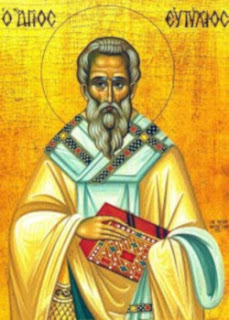
Sainted Eutyches, Archbishop of Constantinople, was born in a village bearing the name "Divine" in the province of Phrygia. His father, Alexander, was a soldier, and his mother Synesia was the daughter of the Augustopolis priest Isichias. Saint Eutyches received the first rudiments of his education and a Christian upbringing from his grandfather the priest. Once during the time of a childhood game the boy wrote his own name with the title of Patriarch and by this seemed to predict his future service. He was sent off to Constantinople at age twelve for continuing further education. The youth persevered in his study of science and realised, that human wisdom is nothing in comparison to the study of Divine Revelation. He decided to dedicate himself to monastic life. Saint Eutyches withdrew into one of the Amasian monasteries and in it accepted the Angelic order. For his strict life he was made archimandrite of all the Amasian monasteries, and in 552 was appointed to the Patriarchal throne.
When the Fifth Ecumenical Council prepared to assemble during the reign of the holy nobleborn emperor Justinian (527-565), the metropolitan of Amasia was ill and he sent in his place Saint Eutyches. At Constantinople the aged Patriarch Saint Minas (536-552) beheld Blessed Eutyches and predicted that he would be the next Patriarch. After the death of the holy Patriarch Minas, the Apostle Peter appeared in a vision to the emperor Justinian and, pointing his hand at Eutyches, said: "Let him be made your bishop."
At the very beginning of his patriarchal service, Saint Eutyches convened the Fifth Ecumenical Council (553), at which the fathers condemned the heresies cropping up and pronounced them anathema. However, after several years there arose a new heresy in the Church, Aphthartodocetism or "imperishability" - which taught that the flesh of Christ, before His death on the Cross and resurrection, was imperishable and not capable of suffering.
Saint Eutyches vigourously denounced this heresy, but the emperor Justinian himself inclined towards it, and turned his wrath upon the saint. By order of the emperor, soldiers seized hold of the saint within the temple, tore off from him his patriarchal vestments, and sent him off into exile to an Amasian monastery (565).
The saint bore his banishment with meekness, and dwelt at the monastery in fasting and prayer, and he worked many miracles and healings.
Through his prayer the wife of a pious man, Androgenes, who before having borne to light only dead infants, now gave birth to two sons who lived to reach years of maturity. Two deaf-mutes received the gift of speech; and two little children, grievously ill, he restored to health. The saint healed a cancerous ulcer on the hand of an artist. The saint healed also another artist, anointing his diseased hand with oil and making over it the sign of the cross. The saint healed not only bodily, but also spiritual afflictions: he banished the devil out of a girl that had kept her from Holy Communion; he banished the devil out of a youth who had fled off from a monastery (after which the youth returned to his monastery); he healed a drunken leper, who, cleansed of his leprosy, stopped drinking.
During the time of an invasion by the Persians into Amasia and its widespread devastation for the inhabitants, by order of the saint they distributed grain to the hungry from the monastic granaries - and the stores of grain at the monastery, through his prayers, were not depleted.
Sainted Eutyches received of God a gift of prophecy: thus, he indicated the names of two successors to emperor Justinian - Justin (565-578) and Tiberias (578-582).
After the death of the holy Patriarch John Scholastikos, Saint Eutyches returned to the cathedra in 577 after his twelve year exile, and he again wisely ruled his flock.
Four and an half years after his return to the Patriarchal throne, Saint Eutyches on Thomas Sunday 582 gathered together all his clergy, gave them a blessing and in peace expired to the Lord.

The Holy Martyrs Agathopodes the Deacon and Theodulus the Reader lived in Thessalonika during the reign of the emperor Diocletian (284-305) and Maximian (284‑305) and were among the church clergy: the holy Deacon Agathopodes was very old, and Saint Theodulus very young.
Both distinguished themselves by righteous life and piety. One tine Saint Theodulus saw in his sleep a vision, in which an unknown person in radiant garb placed in his hand some object. When he awoke, he then saw in his hand a beautiful ring with the image of the Cross and he realised, that this was a sign of his future martyrdom. By the power of the Cross imaged on the ring the saint healed many of the sick and turned pagans to faith in Christ the Saviour.
When the emperor Diocletian issued an edict (303) of a persecution against Christians, many attempted to hide themselves from pursuit, but Saints Agathopodes and Theodulus undauntedly continued to proclaim the Gospel preaching.
The Thessalonika governor Faustinus, having learned of this, gave orders to bring them to him for trial. Seeing the youth and excellence of Saint Theodulus, Faustinus attempted by flattery to persuade him to renounce Christianity and return to the decreed offering of sacrifice. To this the Martyr Theodulus answered that he long since had renounced the error and that he pitied Faustinus, who by his offer of paganism was condemned himself to eternal death. The governor offered the martyr a choice: the fortune of life or immediate death. The saint answered that certainly he would choose life, but as life eternal, and that temporal death he feared not.
When Faustinus lost hope to persuade the Martyr Theodulus, he began to talk with Saint Agathopodes. The governor attempted to deceive him and said, that Saint Theodulus had already agreed to offer sacrifice to the gods. But the Martyr Agathopodes did not believe this. He was convinced, that Saint Theodulus was prepared to offer his life for his True God, the Lord Jesus Christ.
Not having any success, Faustinus commanded to remove the martyrs to prison. The holy martyrs prayed fervently and boldly preached the Word of God to the imprisoned, such that many were converted to Christianity. The head of the prison Eutinios reported about this to the governor.
Faustinus again summoned them to trial and again he urged them to renounce Christ. Before the eyes of Saint Theodulus they brought forth to offer sacrifice those, who earlier were Christians, but betrayed the faith. "Ye have conquered the weak, but strong warriors of Christ ye in no way wilt see to conquer, even if ye do invent yet greater torments!" exclaimed Saint Theodulus. The governor commanded the martyr to produce the Christian books. "Here, my body is given for torture," answered the martyr, "do with it what thou wish; torture me in a very fierce manner, but nonetheless I shalt not hand over the Holy Books for mockery by the impious!"
Faustinus gave orders to bring Saint Theodulus to the place of execution, where an executioner readied a sword in order to cut off his head. The martyr bravely and with joy cried out: "Glory to Thee, O God, Father of my Lord Jesus Christ, Who deigned to suffer for us. Here by His grace I go unto Thee, and with joy I do die for Thee!" Then Faustinus halted the execution and again locked up the martyrs in prison. There the holy martyrs prayed fervently and both saw the same dream. They were sailing in a ship, which during the time of storm was suffering shipwreck. The waves cast them up upon shore, arrayed in white radiant raiment. The saints told each other about the vision, and they gave thanks to God for their impending martyr's end.
In the morning, when the martyrs were again brought to Faustinus, they declared to him: "We are Christians and for the Name of Christ we are prepared to undergo whatever the suffering." Faustinus gave orders to cast them into the sea. The waves carried Saint Agathopodes to the rocks, and he loudly exclaimed: "This shalt be for us a second Baptism, which will wash away our sins, and we shalt come unto Christ with purity." After him Saint Theodulus was also cast into the sea (+303).
The sea cast on shore the bodies of the saints in radiant garb, without the ropes and weight-stones. Christians took their holy bodies and gave them reverent burial.

The Monk Joseph, writer of Church song, was born in Cilicia in a pious Christian family. His parents, Plotinos and Agathea, resettled into the Peloponnesus to save themselves from barbarian invasions. At age fifteen, Saint Joseph departed for Thessalonika and entered a monastery. He distinguished himself by his piety, his love for work, his meekness, and he gained the good-will of all the brethren of the monastery. The monk was later ordained to the dignity of presbyter.
The Monk Gregory Dekapolites visited the monastery and took notice of the young monk, taking him along to Constantinople, where they settled together near the church of the holy Martyrs Sergios and Bakkhos. This was during the reign of the emperor Leo the Armenian (813-820) - a time of fierce iconoclast persecutions. The Monks Gregory and Joseph fearlessly defended the veneration of holy icons. They preached in the squares of the city and visited in the homes of the Orthodox, encouraging them against the heretics. The position of the Constantinople Church was grievous to the extreme: not only the emperor, but also the patriarch were iconoclast heretics.
Pope Leo III - not being under the dominion of the Byzantine emperor - was able to render great help to the Orthodox. The Orthodox monks chose the Monk Joseph as a steadfast and quite eloquent messenger to the Pope. The Monk Gregory blessed him to journey to Rome and to report about the position of the Constantinople Church, and about the dangers threatening Orthodoxy.
During the journey, the Monk Joseph was captured by Arab brigands which had been bribed by the iconoclasts. They took him off to the island of Crete, where they handed him over to the iconoclasts. The Monk Joseph was locked up in prison. Bravely enduring all the deprivations, he encouraged also the other prisoners. Through the prayers of the monk, a certain Orthodox bishop who had begun to waver was strengthened in spirit and courageously accepted a martyr's death.
The Monk Joseph spent six years in prison. On the night of the Nativity of Christ in 820 he was granted a vision of Sainted Nicholas of Myra, who informed him about the death of the iconoclast-oppressor Leo the Armenian, and also the cessation of the persecution over holy icons. Saint Nicholas gave the monk a scroll of paper and said: "Take this scroll and eat it." On the scroll was written: "Hasten, O Gracious One, and attend to our aid in as Thou art the Merciful One, as may be possible and as Thou dost will." The monk read the scroll, ate it and said: How sweet to my throat art these words. Saint Nicholas bid him to sing forth these words. After this the fetters of themself fell off from the monk, the doors of the prison opened up, and he freely emerged from it and was transported in the air and placed down on a large avenue near Constantinople, leading into the city. At Constantinople the Monk Joseph found that the Monk Gregory Dekapolites was no longer among the living, rather only his disciple Blessed John, who likewise soon died. The Monk Joseph built a church in the name of Saint Nicholas and transferred there the relics of the Monks Gregory and John. And nearby the church was founded a monastery.
The Monk Joseph received also part of the relics of the Apostle Bartholomew from a certain virtuous man. He built a church in the name of the holy apostle and wanted to solemnly honour his memory, but he was distressed that there was no laudatory canon of song glorifying the memory of the holy apostle, and he himself did not dare to compile it. For forty days the Monk Joseph prayed with tears, preparing for the feastday in memory of the holy apostle. On the eve of the feast the Apostle Bartholomew appeared to him in the altar, put the holy Gospel to his bosom and blessed him to write church canonical song with the words: "May the right hand of the All-Powerful God bless thee, that thy tongue pour forth waters of Heavenly Wisdom, that thy heart be a temple of the Holy Spirit, and thy church-song be sweet with rejoicing." After this miraculous appearance, the Monk Joseph compiled a canon to the Apostle Bartholomew, and from that time he began to compose canonical song in honour of the Mother of God, of the holy saints and in their midst - in honour of Saint Nicholas, his liberator from prison.
During the period of the renewal of the iconoclast heresy under the emperor Theophilus (829-842), the Monk Joseph suffered a second time from the heretics. He was sent off into exile to Chersonessus for 11 years. The Orthodox veneration of holy icons was restored under the holy empress Theodora in 842, and the Monk Joseph was made keeper of vessels at the Sophia cathedral in Constantinople. But because of his bold denunciation of the brother of the empress, Bardas, for unlawful co-habitation, the monk was again sent off into exile and returned only after the death of Bardas in 867.
Patriarch Photios (857-867, 877-886) restored him to his former position and appointed him father-confessor for all the Constantinople clergy.
Having reached old age, the Monk Joseph fell ill. Just before Pascha, on Great Friday, the Lord informed him in a dream vision about his approaching demise. The monk made an inventory of church articles in the Sophia cathedral, such things as were under his official care, and he sent it off to Patriarch Photios. For several days he prayed intensely, preparing for death. In his prayers the monk besought peace for the Church, and for his soul the mercy of God. Having communed the Holy Mysteries of Christ, the Monk Joseph gave blessing to all that came to him, and with joy he reposed to God (+863). The choirs of the angels and the saints, whom the Monk Joseph had glorified by his canonical song, in triumph carried up his soul to the Heavenly realm.
About the spirit and power of the canon-song of the Monk Joseph, his biographer the Constantinople Church deacon John wrote thus in about the year 890: "When he began to write verses, then the hearing was taken with a wondrous pleasantness of sound, and the heart was struck by the power of the thought... Those that strive for the life of perfection find here a respite... Writers, having left off with their other versification, from this one treasure-trove from the writings of Saint Joseph began to scoop out his treasure for their own songs, or better said, daily they scoop them out. And finally, all the people carry it over into their own language, so as to enlighten with song the darkness of night, or staving off sleep, to continue with the vigil til sunrise... If anyone were peruse the life of a saint celebrated on whatever the day of the Church, they would see the worthiness of song of Saint Joseph and acknowledge his glorious life. Actually, since the life and deeds of almost every saint are adorned with praises, is not he worthy of immortal glory, that hath worthily and exquisitely known how to glorify them! And now let some other saints glorify his meekness, and others - his wisdom, and others - his works, and all together glorify the grace of the Holy Spirit, Which so abundantly and immeasurably hath bestown him his gifts."

The Monk Nicetas the Confessor, hegumen of the Medikion monastery, was born in Bithynian Caesarea (northwest Asia Minor) of a pious family. His mother died eight days after his birth, and his father, named Philaret, was tonsured into monasticism. The infant remained in the care of his grandmother, who raised him in a true Christian spirit. From his youthful years Saint Nicetas attended in church and was an obedient of the hermit Stephanos. With his blessing Saint Nicetas set off to the Medikion monastery, where the hegumen then was Saint Nicephoros.
After seven years of virtuous life at the monastery, famed for its strict custom, the Monk Nicetas was ordained presbyter. And the Monk Nicephoros, knowing the holy life of the young monk, entrusted to him the guidance of the monastery when he himself became grievously ill.
Not wanting power, the Monk Nicetas began to concern himself about the enlightening and welfare of the monastery. He guided the brethren by his own personal example of strict monastic life. Soon the fame of the lofty life of its inhabitants of the monastery attracted there many, seeking after salvation. And after several years the number of monks had increased to a hundred men.
When the Monk Nicephoros expired to the Lord in his extreme old age, the brethren unanimously chose the Monk Nicetas as hegumen.
The Lord vouchsafed Saint Nicetas the gift of wonderworking. Through his prayer a deaf-mute lad was restored the gift of speech; two demon-possessed women received healing; he restored reason to one who had lost his mind, and many others of the sick were healed of their infirmities.
During these years under the emperor Leo the Armenian (813-820), the Iconoclast heresy resumed and the oppression over holy icons intensified. Orthodox bishops were deposed and banished. At Constantinople in 815 a council of heretics was convened, at which they dethroned the holy Patriarch Nicephoros (806-815, +828), and in his place they chose the heretical layman Theodotos. In place of exiled and imprisoned Orthodox bishops they likewise installed heretics. The emperor summoned before him all the heads of the monasteries and tried to draw them over to the Iconoclast heresy. Among those summoned was also the Monk Nicetas, who stood firmly for the Orthodox confession. On his example all the hegumens remained faithful to the veneration of holy icons. For this he was thrown in prison. The Monk Nicetas bravely underwent all the tribulations and encouraged firmness of spirit in the other prisoners.
Then the emperor and the false-patriarch Theodotos attempted to trick with cunning those that persisted. They explained to them that the emperor would give them all their freedom and permit the veneration to the icons on one condition: if they would take Communion from the pseudo-patriarch Theodotos. For a long time the monk had doubts, whether he should enter into church communion with an heretic, but others of the prisoners besought him to partake together with them. Acceding to their entreaties, the Monk Nicetas went into the church, where for the deception of the confessors icons were set out, and he accepted Communion. But when he returned to his monastery and saw, that the persecution against icons was continuing, he then repented of his deed, returned to Constantinople and began fearlessly to denounce the Iconoclast heresy. All threats from the emperor were ignored by him. The Monk Nicetas was again locked up in prison, where he spent six years, until the death of the emperor Leo the Armenian. And there, enduring hunger and travail, the Monk Nicetas by the power of his prayers worked miracles: through his prayer the Phrygian ruler released two captives without ransom; three men for whom the Monk Nikita prayed, who had suffered shipwreck, were delivered up on shore by the waves. In the year 824 under the new emperor Michael (820-829), the Monk Nicetas expired to the Lord. The body of the monk was buried at the monastery with reverence. Afterwards, his relics became a source of healing for those coming to venerate the holy confessor.

The Monk Titus the Wonderworker devoted himself from the time of youth to the monastic life. He pursued asceticism in the ninth century at the Studite monastery near Constantinople. By his deeds of fasting, purity of life and mild disposition the Monk Titus gained the common love of the brethren and at their request he was ordained presbyter. Fervent of faith, the monk stood up bravely for the Orthodox veneration of icons during the time of Iconoclast persecution. For his virtuous life he was granted by God the gift of wonderworking. The saint expired to the Lord in old age.


