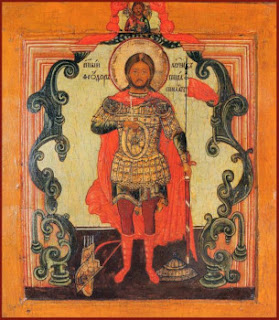
The Great Martyr Theodore Stratelates came from the city of Euchantum. He was endowed with many talents and an handsome appearance. For his charity God enlightened him with the perfective knowledge of Christian truth. The bravery of the saintly soldier became known to many after he, with the help of God, killed a giant serpent living on a precipice in the surroundings of the city of Euchantum. The serpent had devoured many people and animals, holding in terror all the surrounding countryside. Saint Theodore, having armed himself with a sword and a prayer to the Lord, vanquished it, glorifying amongst the people the Name of Christ. For his bravery Saint Theodore was appointed military-commander (stratelates) in the city of Heracleium, where he as it were carried out a dual obedience, combining his official military service with an apostolic preaching of the Gospel among the pagans subject to him. His ardent persuasion, reinforced by his personal example of Christian life, turned away many from the pernicious "false gods." Soon nearly all of Heracleium had accepted Christianity.
During this time the emperor Licinius (307-324) began a fierce persecution against Christians. Wanting to decapitate the new faith, he resorted to making persecution against the enlightened adherents of Christianity, in which not without foundation he saw as the fundamental threat to the dying paganism. Among such was also Saint Theodore. The saint himself invited Licinius to Heracleium, having promised him to offer a sacrifice to the pagan gods. To make this splendid ceremony, the saint requested to be gathered up at his house all the gold and silver statues of the gods which they had in Heracleium.
Blinded by his hatred for Christianity, Licinius trusted the words of the saint. But his expectations were cheated: having seized hold of the statues, Saint Theodore smashed them into pieces which he then distributed to the poor. Thus he shamed the vain faith in soulless idols and literally on the shards of paganism he affirmed the laws of Christian charity. Saint Theodore was arrested and subjected to fierce and refined torture. The witness was the servant of Saint Theodore, Saint Varos, who barely found in himself the strength to write down the incredible torments of his master. Sensing the nearness of death, Saint Theodore yet turned to God with a last prayer, saying: "Lord, Thou hast told me formerly, I am with thee, wherefore dost Thou now abandon me? Behold, O Lord, how the wild beasts do tear at me on account of Thee, my eyes are gored out, my flesh lacerated with wounds, the face is smashed and teeth broken, and they have my bared bones on a cross: remember me, O Lord, having suffered a cross on account of Thee, the iron and fire, and being raised up on nails for Thee: wherefore accept my spirit, since my life doth expire."
God however, by His great mercy, willed that the end of Saint Theodore should be as fruitful for those near him as was his life: He healed the bruised body of the saint and brought him down from the cross, on which he had been left all night. In the morning the imperial soldiers found him alive and unharmed; persuaded in their own eyes of the infinite might of the Christian God, they right there, not far from the place of the unsuccessful execution, accepted holy Baptism. Thus Saint Theodore became "like a day of splendour" for those pagans dwelling in the darkness of idol worship and he enlightened their souls "with the bright rays of his suffering."
Not wanting to flee a martyr's death for Christ, Saint Theodore voluntarily gave himself over into the hands of Licinius, preventing the people believing in Christ from rising up against the torturer, with the words: "Beloved, halt! My Lord Jesus Christ, hanging upon the Cross, held back the Angels and did not permit them to take revenge on the race of man." Going to execution, the holy martyr with but a word opened up the prison doors and liberated those locked up from their bonds. The people also who touched at his robe were restored of body, healed instantly from sicknesses and freed from demons. By order of the emperor, Saint Theodore was beheaded by the sword. Before the death by execution he told Varos: "Neglect not to write down the day of my death, and put my body in Euchantum." Together with these words he asked for an annual remembrance. Then, having said "Amen," he bent his neck beneath the sword. This occurred on 8 February 319, on a Saturday, at the third hour of the day.

Sainted Parthenius, Bishop of Lampsacus, was a native of the city of Melitopolis (Asia Minor), where his father Christopher served as deacon. The youth was not learned at grammar, but he well assimilated the Holy Scripture by being present in church for Divine services. He possessed a good heart, and the money he earned working as a fisherman he distributed to the poor. Filled with the grace of God, Saint Parthenius from age 18 in the Name of Christ healed the sick, cast out demons and worked other miracles.
Learning about the virtuous life of the youth, the Melitopolis bishop Philip gave him an education and ordained him presbyter. In the year 325 during the reign of Constantine the Great, the Kysikhos archbishop Achilles made him bishop of the city of Lampsacus (Asia Minor). In the city were many pagans, and the saint fervently began to spread the faith in Christ, affirming it by the will of God through many miracles and healings of the sick. The people began to forsake their pagan manners of belief, and the saint then went to the emperor Constantine the Great with a petition to tear down the idolous pagan temple and build in its place a Christian church. The emperor received the saint with honour, gave him the edict for the destruction of the pagan temple, and furnished him means for the building of a church. Returning to Lampsacus, Saint Parthenius gave orders to tear down the idolous pagan temple and to erect amidst the city a beautiful church of God.
Having found in one of the torn-down temples a large stone suitable to be made the holy altar-table in the church, the saint gave orders to set to work about it and move it for the construction of the church. Through the malice of the devil, which became enraged at the removal of the stone from the pagan temple, the cart overturned and killed the driver Eutykhion. Saint Parthenius restored him to life by his prayer and shamed the devil, who wanted to frustrate the work of God.
The kindly saint was so great that he refused healing to no one of the multitude coming to him or who chanced to meet him by the wayside, whether suffering bodily illnesses or afflicted with unclean spirits. People even stopped going to physicians, since Saint Parthenius healed all the sick for free, in the Name of the Lord Jesus Christ. With the great power of the Name of Christ the saint banished an host of demons from people, from their homes, and from the waters of the sea. When the saint cast out a devil from a certain man, who had been afflicted by it since childhood, the unclean spirit began to implore the saint to give him another place of habitation. The saint promised to indicate such a place and, having opened his mouth, said to the demon: "Come and dwell in me." The demon, as though stung by fire, cried out: "How canst I go into the house of God?" and vanished off into places desolate and untrodden. An unclean spirit, cast out from the house where the imperial purple dye was prepared, cried out for everyone to hear that a Divine fire was pursuing him with the fire of Gehenna.
Thus, having shown people the great power of faith in Christ, the saint converted a multitude of idol-worshippers to the true God.
Saint Parthenias died peacefully and was solemnly buried alongside the cathedral church of Lampsacus, in a chapel built by him.

The Monk Bucolus, Bishop of Smyrna, was a disciple of the holy Apostle and Evangelist John the Theologian, and was established by him as the first bishop of the Smyrnean Church (Asia Minor).
By the grace of God, Saint Bucolus converted to Christ and baptised many of the pagans, and as an experienced and wise guide he defended his flock from the darkness of heresy. He died at peace in about the years 100-105. He passed his flock on to Saint Polycarp, one of the apostolic fathers, who likewise was a disciple of the holy Apostle John the Theologian. At the grave of Saint Bucolus grew a myrtle tree, which healed the sick.

The Holy Martyress Agatha was the daughter of rich and respected Christian parents from the city of Palermo (formerly called Panorum) in Sicily. During the time of the persecution under the emperor Decius (249-251), the city governor of Catana, Centianus, having heard about the wealth and beauty of Agatha, sent his soldiers after her to bring her to trial as a Christian. At Catana they housed the saint with a certain rich woman who had five daughters. They all attempted to provide temptations for Saint Agatha by means of fine clothes, amusements, and entertainment, urging her to offer sacrifice to the pagan gods, but the saint would not give in to their tricks, and disdaining all the delights, she prayed the Lord to grant her the strength for the act of martyrdom.
At the interrogation under Centianus, the holy martyress was swayed neither by the flattery, nor by the threats, and she was subjected to cruel jeering: they tore at her bosom with iron hooks, and finally, they cut off her breasts. In prison the holy Apostle Peter appeared to her and healed her of her wounds. Led again to torture, Saint Agatha astonished Centianus, in that her bosom was unharmed. They thereupon began to torture her anew. At this moment in the city there began an earthquake, and the earth opened up and swallowed the closest companions of Centianus. The terrified inhabitants rushed to Centianus, demanding that he stop the tortures. Fearing a revolt by the people, Centianus sent Saint Agatha back to prison, where the martyress, in offering up thanks to God, peacefully gave up her soul to the Lord.

The Monk Isidore of Pelusium lived during the fourth-fifth centuries. He was a native of Alexandria, and was raised amidst pious Christians. He was a kinsman of Theophilos, Archbishop of Alexandria, and of his successor, Saint Cyril. While still a youth he quit the world and withdrew within Egypt to Mount Pelusiotes, which became the site of his monastic efforts. The spiritual wisdom and strict asceticism of the Monk Isidore, in combination with his broad erudition and innate knowledge of the human soul, allowed him in a short while to win the respect and love of his fellow monks. They chose him as their head and had him elevated to the dignity of presbyter.
Following the example of Saint John Chrysostom, whom he had managed to see and hear during the time of a journey to Constantinople, the Monk Isidore devoted himself primarily to Christian preaching - that "practical wisdom" which, in his own words, is both "the foundation of the edifice and the edifice itself," while at the same time logic is "its embellishment" and contemplation - its crown."
He was a teacher and a willing giver of counsel for anyone recoursing to him for spiritual encouragement: whether it be a simple man, a dignitary, a bishop, the Patriarch of Alexandria or even the emperor himself. He left after him about 10,000 writings, of which 2,090 have survived. A large portion of these writings are profound in theological thought and contain morally edifying interpretations of Holy Scripture. It is here that the Monk Isidore stands out as the finest disciple of Saint John Chrysostom. The love and devotion of the Monk Isidore for Saint John Chrysostom resulted in decisive acts in defense of Saint John during the time of his persecution by the empress Eudoxia and archbishop Theophilos. After the death of Saint John, the Monk Isidore persuaded Theophilos' successor Saint Cyril to inscribe the name of Saint John Chrysostom into the Church diptychs as a confessor. And through the initiative of the Monk Isidore was convened the Third Ecumenical Council at Ephesus (431), at which was condemned the false teachings of Nestorius concerning the Person of Jesus Christ.
The Monk Isidore lived into old age and died in about the year 436. The Church historian Evagrius (sixth century) writes about the Monk Isidore, that "his life seemed to everyone the life of an angel upon the earth." Another historian, Nicholas Kallistos (ninth century), praises the Monk Isidore thus: "He was a vital and inspired pillar of monastic rules and Divine vision and as such he presented a very lofty image of most fervent example and spiritual teaching."

Righteous Simeon the God-Receiver was, according to the testimony of the holy Evangelist Luke, one of the chosen of God in expectation of the consolation of Israel, and the Holy Spirit dwelt upon him (Lk 2:25). It was announced to him from God that he would not die until that time when the Promised Messiah - Christ the Lord - would be come into the world.
Ancient historians relate that the Egyptian emperor Ptolemy II Philadelphos (285-247 BC) wished to add to the famous Library at Alexandria with texts of Holy Scripture. He invited scholars from Jerusalem, and the Sanhedrin sent their wise men. Righteous Simeon was also among the 72 scholars in Alexandria for the translation of the Sacred Scriptures into the Greek language. (The work was accomplished and received the title "Translation of the 72 Interpreters." With this also further on in the future, the New Testament was translated into the Slavonic language for the Bulgarian, Serbian, and Russian Orthodox Churches.) Righteous Simeon translated a book of the Prophet Isaias, having read in the original the words: "Behold, a Virgin shalt conceive and give birth to a Son." (Is 7:14) He decided, that the word "Virgin" was incorrectly used here in place of the word "Woman," and he wanted to correct the text. At that moment an Angel appeared to him and held back his hand saying: "Have faith in the words written down; thou thyself shalt be persuaded that they will be fulfilled, whereof thou shalt not taste of death until thou behold Christ the Lord, Who shall be born of a Pure and Immaculate Virgin."
From this day righteous Simeon began to await the coming of the Promised Messiah.
And here one day righteous Simeon, knowing of it by the Holy Spirit, was come to the Jerusalem Temple. It was on that very same day (the fortieth after the Birth of Christ), when the All-Pure Virgin Mary and Her Betrothed Joseph had come there in order to perform the ritual set down by Jewish Law - to present before the Lord His Own Divine First-Born and to offer the established sacrifice.
When righteous Simeon beheld their arrival, the Holy Spirit revealed to him that the God-Infant Whom the All-Pure Virgin Mary held was the Promised Messiah, the Saviour of the world. The elder took into his arms the Infant Christ and pronounced his prophetic words: "Now lettest Thou Thy servant depart, O Lord, with peace according to Thy word, wherefore hath mine eyes beheld Thy salvation, which Thou hast prepared before the face of all peoples, a light to the enlightening of gentiles and the glory of Thy people Israel." He blessed the All-Pure Virgin and Righteous Joseph and, having turned to the Mother of God he said: "Behold, This One is set for the fall and rising up of many in Israel and for the sign spoken against, and for Thee thyself a sword shalt pierce the soul, so that the thoughts of many hearts might be revealed." (Lk 2:22-35)
The holy Evangelist relates further: "Here also was Anna the Prophetess, daughter of Phanuel from the tribe of Aser, having reached extreme old age, having lived with her husband for seven years, she was a widow for eighty-four years, who went not out from the temple, serving God both day and night by fasting and prayer. And she having approached at this time, glorified the Lord and prophesied about Him to all awaiting deliverance at Jerusalem." (Lk 2:36-38)
About the righteous and holy Simeon the God-Receiver is known that he died in extreme old age. In the sixth century his holy relics were transferred to Constantinople. In the year 1200 his grave was seen by the Russian pilgrim Saint Antonii, future archbishop of Novgorod (1212-1220, +1232).

On the Feast of the Meeting or Presentation of the Lord, the Church commemorates an important event in the earthly life of our Lord Jesus Christ (Lk 2:22-40). On the fortieth day after birth the God-Infant was taken to the Jerusalem Temple, the centre of religious life of the God-chosen nation. By the Law of Moses (Lev 12) a woman, having given birth to a child of the male gender, was forbidden for forty days to enter into the Temple of God. After this interval the mother came to the Temple with the child, so as to offer to the Lord thanksgiving and a purification sacrifice. The Most Holy Virgin, the Mother of God, did not have need for purification, since without defilement she had given birth to the Source of purity and sanctity, but in profound humility she submitted to the precepts of the Law.
At this time there lived at Jerusalem the righteous elder Simeon. It had been revealed to him that he would not die until he should behold Christ the Saviour. By inspiration from above, the pious elder went to the Temple at that very moment when the Most Holy Mother of God and Righteous Joseph had brought there the Infant Jesus, so as to fulfill the ritual ceremony of the Law. The God-Bearer Simeon took the God-Infant in his arms, and having given thanks to God, he uttered a prophecy about the Saviour of the world: "Now lettest Thou Thy servant depart, O Lord, with peace according to Thy word, wherefore hath mine eyes beheld Thy salvation, which Thou hast prepared before the face of all peoples, a light to the enlightening of gentiles and the glory of Thy people Israel." (Lk 2:29-32) Righteous Simeon said to the Most Holy Virgin: "Behold, This One is set for the fall and rising up of many in Israel and for the sign spoken against, and for Thee Thyself a sword shalt pierce the soul, so that the thoughts of many hearts might be revealed." (Lk 2:35)
Also at the Temple was the 84 year old widow Anna the Prophetess, daughter of Phanuel, "who did not leave the temple, serving God both day and night in fasting and prayer. And she also at that time, having drawn near, glorified the Lord and spake about Him (the God-Infant) to all awaiting deliverance at Jerusalem" (Lk 2:37-38).
Before the Birth of Christ, all righteous men and women lived by faith in the Future Messiah the Saviour of the world, and they awaited His coming. The final righteous ones of the closing Old Testament - Righteous Simeon and the Prophetess Anna - were deemed worthy to meet at the Temple the Bearer of the New Testament, in the Person of Whom both Divinity and humanity do meet.
The Feast of the Meeting of the Lord is among the most ancient feasts of the Christian Church. It is known, that on the day of this solemnity were proclaimed sermons by Sainted Bishops Methodios of Patara (+312), Cyril of Jerusalem (+360), Gregory the Theologian (+389), Amphylokios of Iconium (+394), Gregory of Nyssa (+400), and John Chrysostom (+407). But in spite of its early origin, this feast was not so solemnly celebrated until the sixth century. During the reign of Justinian in the year 528, a catastrophe befell Antioch - an earthquake, in which many people perished. And upon this misfortune there followed others. In the year 544 there appeared a pestilential plague, daily carrying off several thousand people. During these days of widespread travail, it was revealed to a certain pious christian that the celebration of the Meeting of the Lord should be done more solemnly.
When at the day of the Meeting of the Lord the all-night vigil was finally made with church procession, the disasters at Byzantium ceased. In thanksgiving to God, the Church established in 544 that the Meeting of the Lord should be done more solemnly.
Church melodists adorned this feast with many a church work of song: in the seventh century - Sainted Andrew, Archbishop of Crete; in the eighth century - Sainted Cosma, Bishop of Maium; Monk John Damascene; Sainted Germanos, Patriarch of Constantinople; and in the ninth century - Sainted Joseph the Studite, Archbishop of Thessalonika.
With the event of the Meeting of the Lord is associated the icon of the Most Holy Mother of God named: "the Softening of Evil Hearts" or "Simeon's Prophecy," which it is necessary to distinguish from the icon "Seven Arrows."
The icon "Simeon's Prophecy" symbolises the fulfillment of the prophecy of the righteous elder Simeon: "for Thee Thyself a sword shalt pierce the soul." (Lk 2:35)


