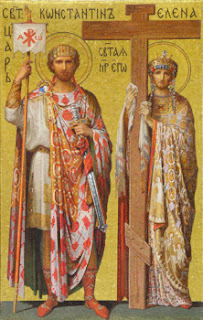
The Holy Emperor Constantine (306-337), has received from the Church the title "Equal-to-the-Apostles," and in world history he received the name "the Great." He was the son of Caesar Constantius Chlorus (305-306), governing the lands of Gaul and Britania. The immense Roman empire was at this time divided into a Western and an Eastern empire, at the head of which were two independent emperors and also co-rulers titled "Caesars," - such in the Western half of the Roman empire was the aforementioned father of Saint Constantine. Saint Contantine's mother was the empress Helen, who was a Christian. The future ruler of all the whole Roman empire, Constantine, was raised to have respect for the Christian religion. His father did not persecute Christians in the lands governed by him, and this at a time when through all the rest of the Roman empire Christians were subjected to fierce persecutions by the emperors Diocletian (284-305) together with his co-ruler Maximian Galerius (305-311) in the East, and the emperor Maximian Hercules (284-305) in the West.
After the death of Constantius Chlorus, his son Constantine in 306 was proclaimed by the army as emperor of Gaul and Britania. The first act of the new emperor was to promulgate in the lands subject to him the freedom of confession of the Christian faith. The pagan fanatic Maximian Galerius in the East and the fierce tyrant Maxentius in the West hated the emperor Constantine and they plotted to overthrow and kill him, but Constantine bested them in a series of battles, and he defeated his opponents with the help of God. He prayed to God to give him a sign, which should inspire his army to fight valiantly, and the Lord manifest to him in the heavens a radiant Sign of the Cross with the inscription "With this Sign thou wilt conquer." Having become sole ruler of the Western half of the Roman empire, Constantine in the year 313 issued the Edict of Milan concerning religious toleration, and in the year 323, when he came to rule as the sole ruler over the whole Roman empire, he extended the conditions of the Milan Edict also over the Eastern half of the Roman empire. After three hundred years of persecution, Christians finally received the possibility to openly confess their faith in Christ.
Renouncing paganism, the emperor did not let his capital remain in ancient Rome, the former centre of the pagan realm. He transferred his capital to the East, to the city of Byzantium, which also was renamed Constantinople ["Constantinopolis" means "the city of Constantine"]. Constantine was deeply convinced that only the Christian religion could unify the immense Roman empire with its diverse peoples. He supported the Church in every way, he brought back from banishment the Christian confessors, he built churches, and he showed concern for the clergy. The emperor deeply revered the victory-bearing Sign of the Cross of the Lord, and he wanted also to find the actual Life-Creating Cross, upon which was crucified our Lord Jesus Christ. For this purpose he dispatched to Jerusalem his own mother - the holy Empress Helen - granting manifold plenitude of power and material means. Together with the Jerusalem Patriarch Makarios, Saint Helen set about the search, and through the Will of God the Life-Creating Cross was discovered in a miraculous manner in the year 326.
Situated in Palestine, the holy empress did much of benefit for the Church. She gave orders that all places connected with the earthly life of the Lord and His All-Pure Mother should be freed of all traces of paganism, and she commanded that churches should be built at these places of memory. Over the Cave of the Sepulchre of the Lord the emperor Constantine himself gave orders to construct a magnificent church to the glory of the Resurrection of Christ. Saint Helen gave the Life-Creating Cross to the Patriarch for safe-keeping, and part of the Cross she took with her for the emperor. Having distributed generous alms at Jerusalem and seeing to the feeding of the needy, during which times she herself attended them, the holy Empress Helen returned to Constantinople, where she soon after died in the year 327.
For her great services to the Church and her efforts in finding the Life-Creating Cross, the empress Helen is titled "Equal-to-the-Apostles."
The peaceful state of the Christian Church was rent by the rise from within the Church by dissensions and quarrels from heresies which had appeared. Already at the beginning of the emperor Constantine's reign there had arisen in the West the heresies of the Donatists and the Novatians, demanding a second baptism over those who lapsed during the times of the persecutions against Christians. These heresies, repudiated by two local Church councils, were finally condemned at the Milan Council of 316. But particularly ruinous for the Church was the rise in the East of the heresy of Arius, daring to repudiate the Divine Essence of the Son of God, and teaching that Jesus Christ was a mere creature. By order of the emperor, in the year 325 there was convened the First Ecumenical Council in the city of Nicea. At this Council were gathered 318 bishops. Among its participants were confessor-bishops from the period of the persecutions and many other luminaries of the Church, among whom was Sainted-hierarch Nicholas of Myra in Lycia. The emperor was present at the sessions of the Council. The heresy of Arius was condemned and a Symbol-Creed of Faith compiled, in which was included the term "of One-Essence with the Father," always confirming in the consciousness of Orthodox Christians the truth of the Divinity of Jesus Christ, Who took on and assumed upon Himself human nature for the redemption of all the human race.
The deep churchly awareness and feeling of Saint Constantine might possibly surprise one, where the working-out of the definition "of One-Essence" heard by him in the disputes of the Council, was at his insistence included within the Symbol-Creed of Faith.
After the Council of Nicea, Saint Constantine continued with his active role in the welfare of the Church. He accepted holy Baptism at the end of his life, having prepared for it all his whole life. Saint Constantine died on the day of Pentecost in the year 337 and was buried in the church of the Holy Apostles, in a crypt earlier prepared by him.
The Martyrs Thalaleus, Alexander, and Asterias: During the reign of Numerian (283-284), the governor of the city of Aegea dispatched soldiers to seek out Christians. They brought to him Thalaleus, an eighteen year old blond-haired youth. To the governor's interrogation Saint Thalaleus answered: "I am a Christian, a native of Lebanon. My father, by the name of Beruchius, was a military commander, and my mother was named Romilia. My brother has the dignity of sub-deacon. I however am a student of medicine under the physician Makarios. During a former time of persecution against Christians in Lebanon I was brought before the governor Tiberias, and just barely escaped execution. But now I stand before this court, do with me what thou dost wish. I desire to die for Christ the Saviour and my God, hoping from Him help to endure all torments."
The enraged governor ordered the two torturers Alexander and Asterias to pierce the legs of the martyr with rope and suspend him head downwards. But the executioners, by the design of God, bored into a block of wood, which they hung up in place of the martyr. When the governor saw that they had deceived him, he then ordered that Alexander and Asterias be fiercely whipped, and they too confessed themselves Christians and glorified God. The governor gave orders to immediately cut off their heads. Twice he himself attempted to carry out the execution, and to pierce the leg-bones of the saint, but the grace of God prevented him, and he in his impotence then commanded that Saint Thalaleus be drowned.
The returning servants reported to the governor that they had carried out the execution, but suddenly, just as they finished their report, Saint Thalaleus appeared in white raiment. For a long while everyone was numbed with terror, but finally the governor said: "Behold, this sorcerer hath bewitched even the sea." Then one of his advisers, the magician Urvician, advised the governor to have the martyr thrown for devouring by wild beasts, but neither the vicious bear, not the hungry lion and lioness, would touch the saint, all meekly but laying down at his feet. Seeing this happen, the people began loudly to shout: "Great is the God of the Christians, O God of Thalaleus, have mercy on us!" The crowd seized hold of Urvician and threw him to the beasts, which did not hesitate to tear apart the magician. Finally, the governor gave orders to kill the holy martyr with a sword. They led away the martyr of Christ to the place of execution, called Aegea, where he prayed to God and bent his neck beneath the sword. This occurred in the year 284. The relics of the holy martyr Thalaleus are situated in the church of Saint Agathonikos of Constantinople and have made many miracles. The holy Martyr Thalaleus, as a physician without payment treating the sick, is called by the Church an Unmercenary, and is called on in prayers over the sick in the Sacrament of Anointing and during the Blessing of Waters.
Saint Patrick lived during the first century and was bishop of the city of Prussa in Bythnia (Asia Minor). He openly and boldly preached the teachings of Christ the Saviour and denounced the error of the pagans. For this he was taken together with the three presbyters - Akakios, Menander, and Polienos, and led for interrogation to the governor of the city, Julius.
At the time Julius was on journey for treatment at an hot-springs, and he gave orders to bring along after him also the Christian bishop with the presbyters, bound in iron chains. Having washed in the hot-springs, Julius offered sacrifice to his gods and, summoning Saint Patrick and the other prisoners, he demanded them to offer sacrifice to the pagan gods, threatening punishments in case of refusal.
Saint Patrick replied to this: "I am a Christian and I worship the One True God, Jesus Christ, Who hath created the heavens and the earth and these warm springs for the benefit of all mankind." On the command of Julius they threw the saint into the hot spring, and with firm faith the martyr prayed for help: "Lord, Jesus Christ, help me, Thy servant," and he remained unharmed.
In a rage of impotence Julius gave orders to cut off the head of Saint Patrick and his three presbyters. The end for the martyrs occurred in about the year 100 after the Birth of Christ.
The Holy Martyr Theodotus and the Holy Seven Virgins - Tecusa, Thaina, Claudia, Matrona, Julia, Alexandra, and Euphrasia, lived during the second half of the third century in the city of Ancyra, Galatia district, and died as martyrs for Christ at the beginning of the fourth century.
Saint Theodotus was an inn-keeper, had his own inn and was married. Then already he had attained to high spiritual accomplishment: he maintained prudence and purity, cultivated temperance in himself, subjugated the flesh to the spirit, and became practised in fasting and prayer. By his conversations he brought Jews and pagans to the Christian faith, and sinners to repentance and improvement. Saint Theodotus received the gift of healing from the Lord and he treated the sick by placing his hands on them.
During the time of the persecution under the emperor Diocletian (284-305), a certain Theoteknes, known for his cruelty, was appointed as governor in the city of Ancyra. Many Christians fled from the city, having forsaken their homes and property. Theoteknes made a proclamation to all Christians that they were under obligation to offer sacrifice to idols, and in the event of refusal they were to be given over to torture and death. Pagans delivered Christians over to torture, and then divided up their property.
A famine befell the country. During these grim days, Saint Theodotus gave shelter in his inn to Christians left homeless. He fed them, hid away those being pursued, and from his supplies gave to devastated churches everything necessary for making the Divine Liturgy. He fearlessly went into the prisons, rendering help to the innocently condemned, encouraging them to be faithful to Christ the Saviour to the very end. Theodotus did not fear to bury the remains of holy martyrs, either carrying them off secretly or ransoming them from the soldiers for money. When the Christian churches at Ancyra were destroyed and closed, Divine Liturgy began to be celebrated in his inn. Perceiving that the deed of martyrdom awaited him too, Saint Theodotus in conversation with the priest Phrontonos predicted that in a short while they would bring to him the relics of martyrs, at a place chosen by both of them. In surety of his words, Saint Theodotus gave his ring to the priest.
During this while, seven holy virgins had accepted death for Christ, of whom the eldest - Saint Tecusa - was an aunt of Saint Theodotus. The holy virgins - Tecusa, Thaina, Claudia, Matrona, Julia, Alexandra, and Euphrasia - from their youth had dedicated themselves to God, and lived in constant prayer, fasting, temperance, and good deeds. All of them had attained to an elderly age. Brought to trial as Christians, the holy virgins in front of Theoteknes bravely confessed their faith in Christ and were given over to torture, but remained steadfast. The governor thereupon gave them over to shameless youths for desecration. The holy virgins prayed intensely, asking help from God. Saint Tecusa fell down at the feet of a youth, and taking back her veil she showed him her greyed hair. The youths became startled, started weeping and ran off. The governor then ordered that the saints take part in "the ablution of the idols," which was done by pagan priests, but again the holy virgins refused. For this they were sentenced to death. A heavy stone was tied to the legs of each, and all seven of the holy virgins was drowned in a lake.
On the following night Saint Tecusa appeared in a dream to Saint Theodotus, asking him to take up her body and give it Christian burial. Saint Theodotus, taking with him his friend Polychronios and several other Christians, set off to the lake. It was dark, and a burning torch led the way. Amidst them in front of the guard, posted by the pagans at the shore of the lake, appeared the holy martyr Sosander. The frightened guard ran off in terror. The wind drove the water towards the other side of the lake. The Christians took up the bodies of the holy martyresses and carried them to church, whence they were given over to burial.
Learning about the theft of the bodies of the holy martyresses, the governor went into a rage and gave orders to strike at all Christians and give them over to torture. Polychronios also was seized. Not able to endure the torture, he informed on Saint Theodotus, as the perpetrator of the theft of the bodies. Saint Theodotus began to prepare to die for Christ; having come up together with all the Christians zealous in prayer, he made bequest of his body to the priest Phrontonos, to whom earlier he had given his ring. The saint came before the judge. They showed him various instruments of torture and instead of them they promised him honours and riches, if he recanted from Christ. Saint Theodotus glorified the Lord Jesus Christ, and confessed his faith in Him. In anger the pagans gave the saint over to constant torture, but the power of God sustained the holy martyr. He remained alive and was cast into prison. On the following morning the governor again gave orders to torture the saint, but he soon perceived that it was impossible to break his courage. He then gave orders to behead the martyr. The execution was done, but sensing that a storm was approaching, the soldiers set fire to the body of the martyr. And soldiers, sitting in a tent, remained to guard the body. At this point the priest Phrontonos appeared from a nearby way, leading a donkey with a load of wine from his vineyard. The donkey suddenly fell down near the place where lay the body of Saint Theodotus. The soldiers helped get the donkey back up and they told Phrontonos that they were guarding the body of the executed Christian Theodotus. The priest perceived that the Lord had intentionally sent him hither. He placed the holy remains on the donkey and took them to the place, indicated by Saint Theodotus for his burial, and with honour he committed them to the earth. Afterwards he built up a church on this spot. Saint Theodotus accepted death for Christ on 7 June 303 or 304, and his memory is commemorated on 18 May, on the day of death of the holy virgins.
The account of the life and martyr's act of Saint Theodotus and the suffering of the holy virgins was compiled by the contemporary and companion of Saint Theodotus, and an eye-witness of his death - Nilos, living in the city of Ancyra during the period of persecution of Christians under the emperor Diocletian.
The Holy Disciple from the Seventy Andronicus, and his helper in apostolic works, Saint Junia, were relatives of the holy Apostle Paul. They laboured much, preaching the Gospel to pagans, about which the Apostle Paul makes mention in his Epistle to the Romans: "Greet Andronicus and Junia, my kinsfolk and prisoners with me, acknowledged amongst the Apostles and having still before me believed in Christ" (Rom. 16: 7).
Saint Andronicus was ordained bishop of Pannonia, but the preaching took Saint Junia and him also to other lands, far from the boundaries of his diocese. By the efforts of Saints Andronicus and Junia the Church of Christ was strengthened, pagans were converted to the knowledge of God, many pagan temples ceased functioning, and in their place were erected Christian churches. From the service in honour of these saints it is known, that they suffered martyrdom for the Name of Christ.
In the fifth century, during the reign of the emperors Arcadius and Honorius, their holy relics were uncovered on the outskirts of Constantinople together with the relics of other martyrs "at the Eugenius gate."
It was revealed to the pious cleric Nicholas Kalligraphos that among these seventeen martyrs were also the relics of the holy Disciple Andronicus. Afterwards on this spot was built a magnificent church.
The Monk Theodore was called "Sanctified" because he was the first in his monastery ordained to the priesthood.
The Monk Theodore came from Egypt and was the son of rich and illustrious Christian parents. The yearning for monastic life early showed up in him. One time at the house of his parents during the feast of Theophany there was a large party, and the lad did not want to take part in the festivities, grieving that because of earthly joys he would be deprived of joys in the life to come. At fourteen years of age he secretly left home and settled in one of the monasteries.
Hearing about Pachomius the Great, he burned with the desire to see the ascetic. The Monk Pachomius received the arriving lad with love, having been informed by God beforehand about his coming. Remaining at the monastery, the Monk Theodore quickly succeeded in all his monastic tasks, particularly in the full obedience to his guide and in his compassion towards the surrounding brethren. Theodore's mother, learning that he was at the Tabennisa monastery, came to the Monk Pachomius with a letter from the bishop, imploring a meeting with her son. But the Monk Theodore, fearing to break his vow of renunciation from the world, refused to meet with his mother.
Seeing the strength of mind and ability of Saint Theodore, the Monk Pachomius once directed him to speak an instruction to the brethren on Holy Scripture. Saint Theodore was then but twenty years old. He unquestioningly obeyed and began to speak, but certain of the older brethren took offence that a newly begun monk should read them a discourse, and they departed. The Monk Pachomius thereupon said to them: "Ye have given in to the devil and by your conceit your efforts art come to naught. Ye rejected not Theodore, but rather the Word of God, and have deprived yourselves of the Holy Spirit."
Saint Pachomius appointed the Monk Theodore as overseer of the Tabennisa monastery, and withdrew to a more solitary monastery. Saint Theodore with filial love continued to concern himself over his instructor, and in the final illness of the Monk Pachomius he looked after him, and when the great abba reposed to the Lord, he closed his eyes. After the death of the Monk Pachomius, Saint Theodore directed the Tabennisa monastery, and later on he was at the head of all the Thebaid monasteries. The Monk Theodore the Sanctified was famed for holiness of life and a copious gift of wonderworking, and he was well known to Saint Athanasius, Patriarch of Alexandria. Saint Theodore reposed in his old age in the year 368.

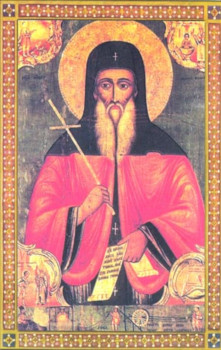
The Monk Pachomius the Great, together with Anthony the Great, Macarius the Great, and Euthymius the Great, was both an exemplar of wilderness dwelling, and a founder of the monastic "life-in-common" coenobitism in Egypt. The Monk Pachomius was born in the third century in the Thebaid (Upper Egypt). His parents were pagans and he received an excellent secular education. From youth he had the traits of good character, he was prudent of sensible in mind. When Pachomius reached age twenty, he was called up into the army of the emperor Constantine (in the year 315). They settled the new conscripts into the edifice of a city prison under a guard of sentries. The local Christians came with supplies of food, and they fed the soldiers and took sincere care of them. When the youth learned that these people acted thus for the sake of their God, fulfilling His commandment about love for neighbour, this made a deep impression upon his pure soul. Pachomius made a vow to become a Christian. Having returned from the army after the victory, Pachomius accepted holy Baptism, resettled himself into the lonely settlement of Shenesit and immediately he began to lead a strict ascetic life. Sensing the need for spiritual guidance, he turned to the Thebaid wilderness dweller Palamon. He was fondly accepted by the elder, and he began to proceed through monastic efforts on the example of his instructor.
One time, after ten years of wilderness life, the Monk Pachomius was making his way through the desert, when he halted at the ruins of the former village of Tabennis and here he heard a Voice, ordering him to form at this place a monastery. Pachomius reported about this to the elder Palamon, and they both considered the words heard to be a command from God. They set out to Tabennis and began by building there a small monastic hovel. The holy elder Palamon blessed the beginning foundations of the monastery and made a prediction of its future glory. But soon also the Monk Palamon expired to the Lord. An Angel of God then appeared to Saint Pachomius in the form of a schemamonk and entrusted to him an ustav-rule of monastic life. And soon his own elder brother John came and settled there together with him.
The Monk Pachomius underwent many a temptation and assault from the enemy of the race of man, but the Monk Pachomius bravely warded off all the temptations by his prayer to God and endurance.
Gradually there began a gathering of followers to the Monk Pachomius. Their teacher impressed everyone by his love for work, whereby he managed to accomplish all kinds of monastic tasks: he cultivated a garden, he conversed with those that arrived seeking guidance, and he tended to the sick. The Monk Pachomius introduced a monastic rule of "life-in-common," making everything the same for everyone in food and attire. The monks of the monastery were to toil at the obediences assigned them for the common good of the monastery. Among the various obediences was the re-copying of books. The monks were not to possess their own money nor to accept anything from their kinsfolk. The Monk Pachomius considered that an obedience, fulfilled with zeal, was higher than fasting or prayer, and he demanded from the monks an exact observance of the monastic rule, strictly chastising flaggards.
To the Monk Pachomius one time came his sister Maria, who for a long time had wanted to see her brother. But the strict ascetic refused seeing her and via the gatekeeper he gave her the blessing to enter upon the path of monastic life, promising his help with this. Maria wept, but did as her brother had ordered. The Tabennis monks built her a hut on the opposite side of the River Nile. And to Maria also there began to gather nuns, and soon there was formed a women's monastery with a strict monastic rule, provided by the Monk Pachomius.
The number of monks at the monastery grew quickly, and it necessitated the building of seven more monasteries in the vicinity. The number of monks reached 7,000 - all under the guidance of the Monk Pachomius, who visited at all the monasteries and administered them. But at the same time Saint Pachomius remained a deeply humble monk, who was always ready to comply with and accept the remarks of each brother.
Severe and strict towards himself, the Monk Pachomius had great kindness and condescension towards the spiritually immature deficiencies of monks. One of the monks was ardent for the deed of martyrdom, but the Monk Pachomius swayed him from this yearning and instructed him quietly to fulfill his monastic obedience, taming the pride in himself and training him in humility. One time a monk would not heed his advice and went off from the monastery, during which time he was set upon by brigands, who under the threat of death forced him to offer sacrifice to the pagan gods. Filled with despair, the monk returned to the monastery. The Monk Pachomius ordered him to pray intensely night and day, keep strict fast and live in complete solitude. The monk followed his advice, and this saved his soul from despair.
The monk taught to avoid against judging others and he himself feared to be judgmental of anyone even in thought.
It was with an especial love that the Monk Pachomius concerned himself over the sick monks. He visited them, he cheered up the disheartened, he urged them to be thankful to God and put their hope in His holy will. For the sick he lightened the fasting, if this should aid in their recovery of health. One time in the absence of the monk, the cook did not prepare the monks any cooked food, on the presumption that the brethren loved to fast. Instead of doing his obedience, this monk plaited 500 mats, something which the Monk Pachomius had not encouraged. In punishment for the disobedience, all the mats prepared by the cook were ordered burnt.
The Monk Pachomius always taught the monks to have hope only upon the help and mercy of God. At the monastery it happened that there was an insufficiency of grain. The saint spent the whole night at prayer, and in the morning there came from the main city a large quantity of bread for the monastery, at no expense. The Lord granted the Monk Pachomius the gift of wonderworking and healing the sick.
The Lord revealed to him the ultimate fate of monasticism. The monk learned that successive monks would not have such zeal in their efforts as did the first, and they would walk in the darkness of not having experienced guides. Prostrating himself upon the ground, the Monk Pachomius wept bitterly, calling out to the Lord and imploring mercy for them. In answer he heard a Voice: "Pachomius, be mindful of the mercy of God. About the monks to come, know that they shalt receive recompense, since that they too shalt have occasion to suffer the life burdensome for the monk."
Towards the end of his life the Monk Pachomius likewise fell ill from a pestilence that afflicted the region. His closest and beloved disciple, the Monk Theodore, tended to him with a filial love. The Monk Pachomius died in about the year 348 at age 53, and he was buried on an hill near the monastery.